
Why the Same Local SEO System Ranks a Plumber and a Periodontist
“Can you show me a few examples of businesses like ours where you’ve improved local rankings and lead generation?”
I get a version of that email from many new prospects. A dentist wants to see dental practices. A roofer wants roofers. A design firm wants other design firms. It sounds like due diligence, and I understand the instinct. Nobody wants to pay any consultant to “learn” on their dime.
The question rests on one assumption: that local SEO for small business works differently depending on the industry.
It does not.
I have spent over 23 now years ranking businesses in niches from pool remodeling to mobile welding to wedding planning, and the system is the same every time. What changes is vocabulary. What never changes is the mechanism.
The numbers explain why this matters more than any industry credential.
According to SOCi’s 2024 Consumer Behavior Index, 80% of consumers search online for local businesses at least once a week, and 32% do it every day. BrightLocal’s 2026 survey found that 97% of consumers read reviews for local businesses, most of them on Google.
Your client prospects are already searching; the only question is whether they find you or someone else.
Google Doesn’t Rank Industries. It Ranks Relevance, Distance, and Prominence.
You do not have to take my word for this. Google publishes its local ranking factors, and there are exactly three: relevance, distance, and prominence.
- Relevance means your listing and website clearly describe what you do.
- Distance means how far you are from the searcher.
- Prominence means how well known and well reviewed your business is, online and off.
The stakes of those three factors are brutal. Backlinko’s 2025 click-through study of 12 million queries found that the top organic result takes 27.6% of clicks, while only 0.63% of searchers click anything on page two.
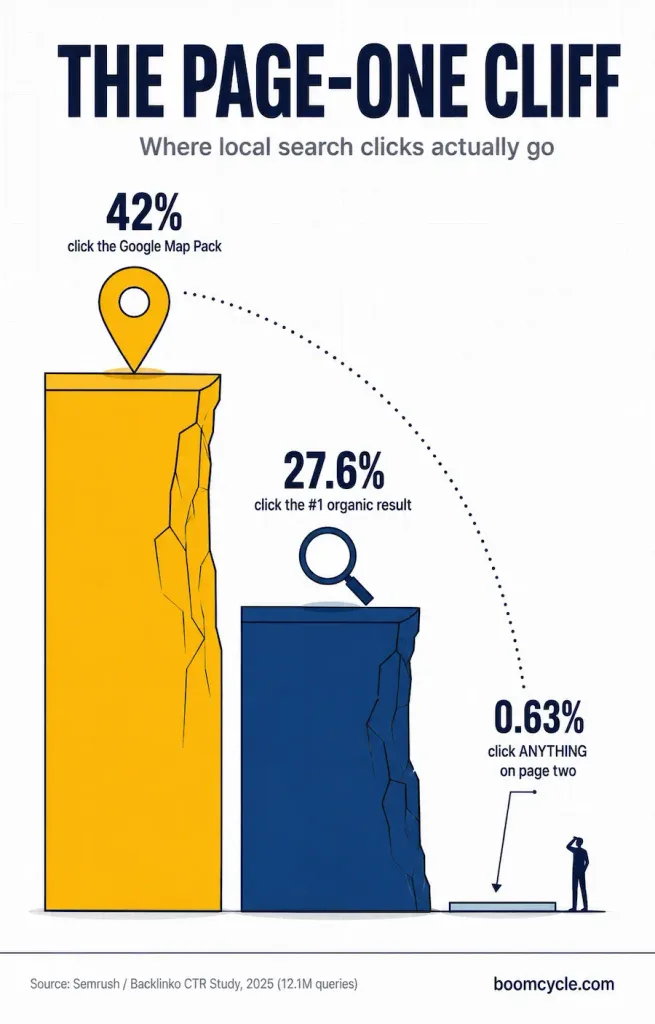
In local results, 42% of searchers click the map pack, the block of three businesses Google shows with the map. If you are not visible in those few positions, you functionally do not exist for that search. I wrote a full breakdown of how those positions work in my guide to Google Maps SEO and the map pack.
Your business category is a field you declare in your Google Business Profile. It tells Google what searches you belong in.
So the real product of any local SEO strategy is visibility in a handful of positions that every business in your city is fighting for. The fight looks identical whether the combatants are plumbers or portrait photographers.
Four Businesses, One Playbook
To prove the point, walk through four businesses that share nothing operationally. Different price points, different sales cycles, different customers, different licenses. Watch what happens to the differences when their customers start searching.

The Plumber: Emergency Visibility
A burst pipe compresses the entire sales funnel into about ten minutes. Research from Invoca shows 54% of customers research plumbing services online before scheduling, and 92% of consumers weigh online reviews before hiring a home-service business.
When the search happens at midnight with water on the floor, the map pack is the shortlist. The plumber who appears there with 4.8 stars and 200 reviews gets the call. The better plumber with no visibility gets nothing.
For the plumber, the work is a complete Google Business Profile, a steady stream of reviews, service pages for water heaters and drain cleaning and repiping, and consistent listings across the web. I cover the niche in detail in my plumbing marketing guide, and every tactic in it is an application of relevance, distance, and prominence.
The Dentist: Trust Visibility
Nobody picks a dentist with water on the floor. The research cycle runs days or weeks, and it runs on reviews. RepuGen’s 2024 patient survey found 84% of patients visit review sites to evaluate healthcare providers. First Page Sage’s practice data shows dental websites convert 3.0% of visitors into prospective patients, and 76.9% of prospects who arrive through search become patients. Search-driven patients close at a rate most marketing channels never touch, because they arrived already looking for exactly what the practice offers.
The work for the dentist? A complete profile, review velocity with thoughtful responses, service pages for implants and Invisalign and emergency visits, consistent citations. The same machine, tuned for a longer decision.
My playbook for SEO for dentists maps every step.
The Financial Planner: Referral Visibility
Financial planners love to tell me their business is pure referral, so search does not matter. The data says otherwise. Wealthtender’s 2025 study of affluent households found that 96% of prospects research a financial advisor online before making contact, even when a friend personally referred them. SEO does not replace referrals. It is where your referrals go to verify you exist.
A referred prospect who finds a thin website, a bare Google profile, and three reviews quietly moves on, and the planner never learns the referral happened. The fix is the same machine again, with proof points swapped in: credentials instead of licenses, planning-specialty pages instead of drain-cleaning pages.
I wrote about the niche in digital marketing for financial advisors.
The Residential Remodeler: Discovery Visibility
I picked this niche deliberately, because almost nobody writes a local SEO playbook for residential remodelers. However, I pitched a prospect in this niche in June 2026, so I did some research. While word-of-mouth is the best channel, it is not a growth strategy; it’s more like “luck of the draw”.
When a residential remodeler would like to grow their business outside their own network, they need to look to other channels…starting with Google Search and the Map Pack.
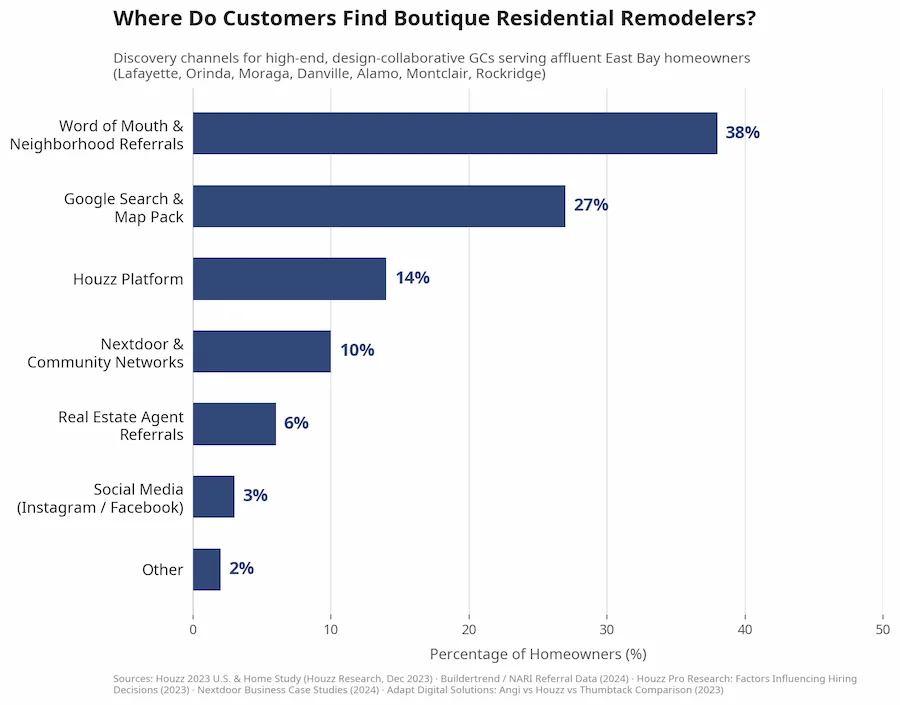
Here is the part that answers the email at the top of this article. The playbook works for the remodeler anyway. A complete profile in the right categories, a portfolio that doubles as service pages, reviews from finished projects, consistent citations.
The map pack does not know or care what a niche is. It knows relevance, distance, and prominence, and it rewards whoever feeds it best.
What Changes Between Niches (and What Never Does)
| Changes with the niche | Never changes |
|---|---|
| Keyword vocabulary (repiping vs. Invisalign vs. fiduciary vs. whole-home design) | Google Business Profile completeness and category strategy |
| Content topics and page structure | Review velocity, recency, and owner responses |
| Proof points (licenses, credentials, portfolios, before-and-afters) | Dedicated service and location pages |
| Decision speed (minutes for emergencies, months for planners) | Consistent name, address, and phone across the web |
| Compliance rules in regulated fields | A fast, healthy website that converts visits into calls and forms |
Study the right column. Those five items are the whole game, in every niche, and the column that never changes is the one that produces customers. The left column matters, but it is vocabulary. Any competent agency learns vocabulary in the first two weeks of an engagement.
What Niche Experience Actually Buys (and What It Can’t)
I am not going to pretend industry experience is worthless. It buys three real things: fluency in your customers’ language, a faster content ramp because the agency already knows a water heater from a tankless unit, and awareness of advertising compliance rules in regulated fields like finance and healthcare. Those are conveniences. They shorten the runway by a few weeks.
What niche experience cannot buy is rankings. Google evaluates your business, your website, your reviews, and your proximity to the searcher. An agency’s portfolio of similar logos is invisible to the algorithm. I have watched niche-specialist agencies produce beautiful industry-specific content for businesses that stayed invisible, because the specialist knew the industry and did not know the machine.
The Questions That Actually Qualify an SEO Agency
If “have you worked with businesses like mine” is the wrong question, what should you ask instead? These are the questions I would want answered before hiring anyone, including me:
- What exactly is in your audit? A real audit covers your Google Business Profile, reviews, service pages, citations, site health, and your actual ranking positions across your service area, with evidence for every finding.
- What deliverables land in month one, and what lands in month three? Vague answers here predict vague invoices later.
- How do you measure results? The honest answer involves calls, form fills, and booked work, and rankings as the leading indicator. Anyone selling rankings alone is selling the scoreboard instead of the game.
- Who does the work? You want to know whether strategy and execution sit with the person you are talking to or with a subcontractor three time zones away.
- What happens when something is not moving? Every campaign hits a plateau. The agency’s answer tells you whether they diagnose or excuse.
An agency that answers the process questions well will outperform a niche specialist with a prettier portfolio every time.
But Isn’t SEO Dead? (The AI Question)
You have probably seen the argument: big publishers are losing organic traffic to AI answers, so SEO is finished. The first half is true. The conclusion confuses two different things.
What is shrinking is national informational traffic, the recipe blogs and how-to listicles whose answers an AI can simply give. Semrush’s study of more than 10 million keywords found AI Overviews appeared on 15.69% of Google queries in late 2025, having peaked near 25% in the summer.
Most queries still resolve through classic results, and local moment-of-need searches resolve through the map pack and Google Business Profiles, which AI Overviews cite rather than replace. When someone asks an AI assistant for a good dentist nearby, the assistant reads the same visibility signals this article has been describing: profiles, reviews, prominence. I wrote more about where this is heading in my piece on Google’s AI Overviews.
The searcher with the burst pipe still needs a human with a wrench. AI changed how the question gets asked, but it did not change who wins the answer.
The Math: What Local SEO Returns
A local agency which publishes the most credible ROI data in the industry from its own client campaigns, reports a median SEO ROI of 748% with a break-even around month nine. Their per-industry table makes the cross-niche case for me: financial services campaigns return 1,031%, construction returns 681%, and HVAC returns 678%. There is no plumbing row in their data, so I cite construction and HVAC as the honest proxies for the trades.
Two expectations keep those numbers real. Local SEO is a compounding asset, so month two looks quiet and month twelve looks inevitable. And cost scales with your market, your competition, and how far behind you start. I published full pricing ranges in my SEO services pricing guide so you can sanity-check any quote you receive, including mine.

When Local SEO Is Not the Right Tool
Part of being straight with you is admitting when I would not sell you this service. Local SEO is the wrong tool when:
- You need calls this week. Google Ads and Local Services Ads produce leads in days. SEO produces them in months and then keeps producing them. The sequencing matters.
- You are already at capacity. Visibility that generates calls you cannot answer buys you one-star reviews.
- Your reviews reflect a service problem. Ranking a 3.2-star business higher amplifies the problem. Fix operations first.
- You serve one or two contracted clients. A subcontractor with all revenue flowing through a general contractor has no local search demand worth capturing.
If any of those describe you, I will tell you on the first call, because a client who should not have bought SEO becomes a cancellation with a story to tell.
Local SEO for Small Business: The Universal Checklist
One checklist, any niche. This is the 20% of local SEO strategy that does 80% of the work:
- Claim and completely fill out your Google Business Profile, every field, every service.
- Choose your primary category deliberately and add the most critical legitimate secondary categories. Some SEOs see advantages in focusing on only ONE primary category only, others say add as many secondary categories as possible. This one is open for some debate, but your primary category is a must-have.
- Build a repeatable system for asking happy customers for Google reviews, and respond to every one.
- Create a dedicated page for each core service, written for humans first.
- Keep your name, address, and phone number identical across every directory that lists you.
- Add photos of real work and real people monthly. Stock photography convinces no one.
- Make the site fast, mobile-first, and honest about what you do and where you do it.
- Track calls and form fills, not just rankings, so you know what the visibility is worth.
Frequently Asked Questions
Does my SEO agency need experience in my industry?
No. Google ranks businesses on relevance, distance, and prominence, and none of those factors can see an agency’s client list. Industry experience shortens the vocabulary ramp by a few weeks. Ask process and measurement questions instead, and expect clear answers.
Is local SEO worth it for a small business?
The median SEO campaign returns 748% ROI with break-even around month nine, per client data. For any business whose customers search locally, the honest answer is yes, provided you can wait out the ramp and handle the added work.
How much does local SEO cost for a small business?
Cost depends on market size, competition, and your starting point. Most legitimate local campaigns for small businesses run between several hundred and a few thousand dollars per month. My pricing guide linked above breaks down the ranges and the red flags.
What is the 80/20 rule of SEO?
For local businesses, the 20% of effort that produces 80% of results is the same in every niche: a complete Google Business Profile, steady reviews with responses, and dedicated service pages. Everything else builds on that base.
The Same Machine, Your Business
The niche question feels safe to ask because it has a countable answer. But it filters for agencies that are good at collecting logos, and what you need is an agency that is good at visibility. The plumber, the dentist, the financial planner, and the interior designer all get found the same way, by the same three factors Google has published for years.
If you want to know where your visibility actually stands, I will show you. My local SEO and Google Maps marketing work starts with an audit that maps your rankings across your service area, position by position, and I walk you through every finding myself. Send me a note and tell me what your customers type when they need you. That answer matters more than your industry ever will.