
58.5% of Google searches now end without a single click.
And the searches that do produce clicks? The top organic position has seen its click-through rate fall from 28% to 19% in recent years, driven largely by AI Overviews, ads, and knowledge panels that now dominate the top of the page.
It probably makes sense to learn more about how people actually use Google before you build your strategy around outdated assumptions.
If that sounds bleak, here’s the counterweight: organic search still costs 61% less per lead than paid advertising, and the median search engine optimization (SEO) ROI comes in at 748%. The channel works. The playing field just changed.
“Top of Google” means something different in 2026 than it did five years ago. And this here guide walks through what actually matters now: by business type, by search intent, step by step…so you’re competing for the placements that still drive real traffic, not just chasing rankings that have already been pushed below the fold.
Why “Top of Google” Looks Different in 2026
The results page is no longer a list of links.
Sponsored ads now blend into organic listings in ways designed to be hard to distinguish. AI Overviews synthesize answers from multiple sources and present them directly in the results — Ahrefs research from February 2026 found that AI Overviews suppress organic click-through rates by 58% on affected queries. Seer Interactive found that organic CTR for AIO-prone queries dropped 61% compared to queries without AI Overviews.
Zero-click searches — where users find their answer without visiting any website — are the norm, not the exception. According to SparkToro and Datos, 58.5% of searches end this way.

That’s the bad news. Here’s the good news: the businesses that adapt win disproportionately. Winning in 2026 looks like this:
- Your business appears in traditional organic listings for core service queries
- You dominate the Map Pack for “near me” searches
- Your content earns featured snippets and People Also Ask placements
- For key informational queries in your industry, you’re cited as a source in AI Overviews
That’s a lot of surfaces to own. Here’s how to do it.
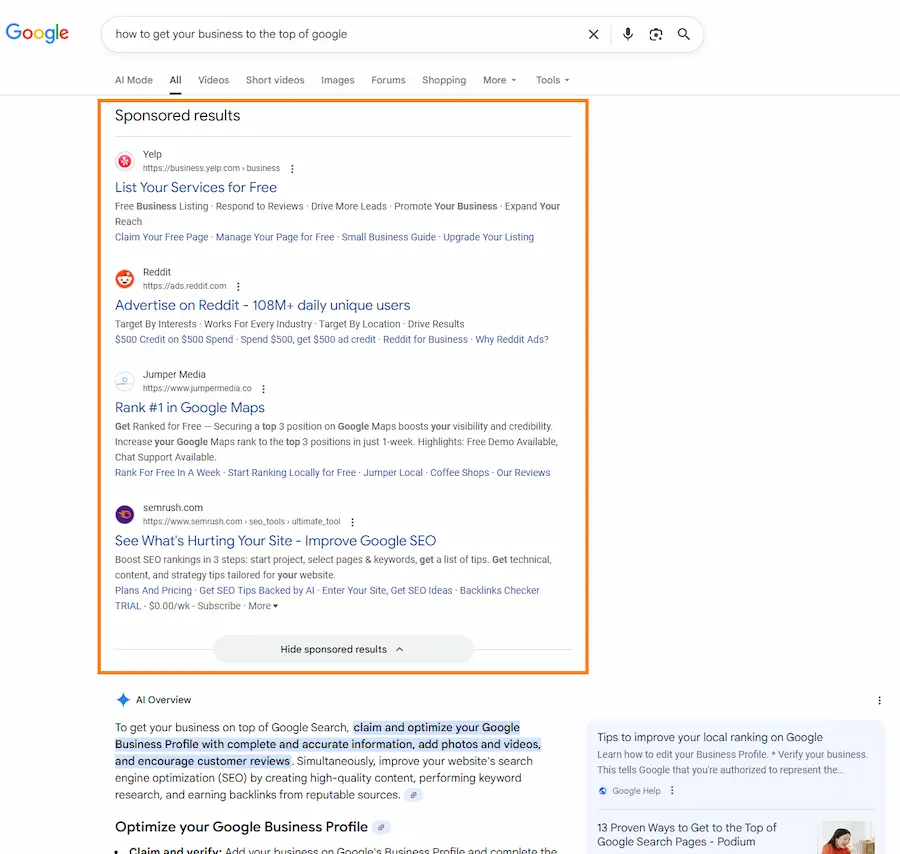
Notice how cleverly Google has now “hidden” the sponsored results in plain sight!
Step 1: Identify Your Business Type and Search Intent
Before you can show up at the top of search results, you need to understand which results actually matter for your business. A neighborhood dental practice and a national SaaS company face completely different challenges.
Local brick-and-mortar businesses
Local brick-and-mortar businesses like restaurants, retail shops, medical practices, and professional services live or die by the Local Map Pack. When someone searches “dentist near me” or “coffee shop downtown,” those three businesses with the map pins get the lion’s share of clicks. The customer must come to them.
Service-area businesses
Service-area businesses like plumbers, HVAC contractors, moving companies, and home services need both Map Pack visibility and strong organic rankings for queries like “emergency plumber in [city]” or “AC repair cost.” These are the businesses that go wherever their customer needs them.
Multi-location and regional brands
Multi-location or regional brands must balance corporate-level authority with individual location optimization. Each branch needs its own presence while the parent brand builds topical authority. Think larger service-area businesses: swimming pool construction companies, interior designers, specialized and bespoke services.
Online-only businesses
Online-only businesses including e-commerce sites, SaaS platforms, and digital service providers compete purely in organic listings and need content that addresses every stage of the buyer journey.
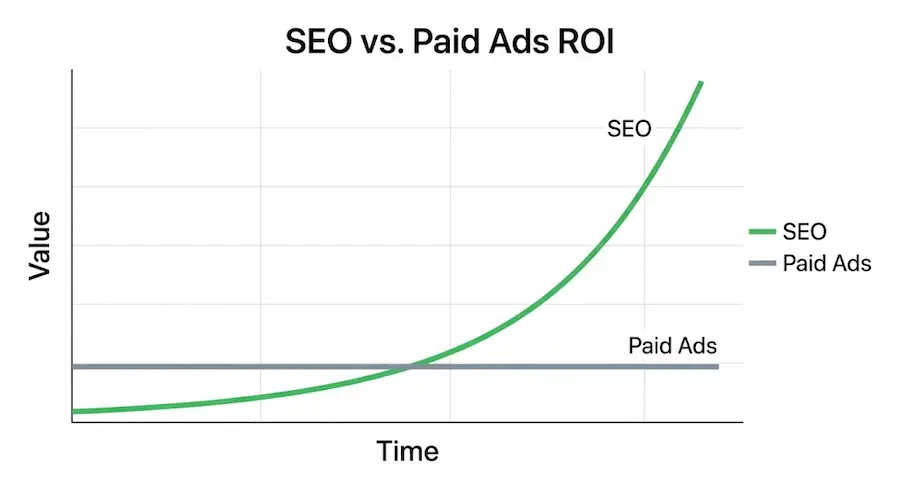
Over the long haul, SEO has proven to deliver far better ROI than paid ads, even in 2026.
Step 2: Match Your Goals to Search Intent with Targeted Keywords
Search intent is the why behind every query, and Google has gotten remarkably good at interpreting it. Miss the intent and your page won’t rank, no matter how well-written it is.
The four types of search intent
| Intent Type | Example Queries | Typical SERP Features | Content to Create |
|---|---|---|---|
| Informational | “how to save for retirement,” “what is keyword difficulty” | AI Overviews, featured snippets, People Also Ask | In-depth guides, how-tos, explainers |
| Commercial | “best CRM for small business,” “HVAC brands compared” | List articles, review sites, comparison pages | Comparison content, “best of” listicles |
| Transactional | “buy running shoes online,” “schedule pest control” | Shopping results, local ads, service pages | Service/product pages with clear CTAs |
| Local | “pizza delivery,” “urgent care open now,” “plumber in Fremont” | Map Pack, Local Services Ads, local organic | Google Business Profile + location pages |
“LLMs like ChatGPT or Google’s AI Overviews are lazy shoppers who love ‘Best of’ listicles because they bundle popular options into easy recommendations. The result is a self-reinforcing loop where brands that already have visibility keep getting cited, while smaller alternatives stay invisible.”
David Victor, Boomcycle Digital Marketing
The content you create and the pages you optimize must align with the intent behind your target searches. A plumber trying to rank for “how to fix a leaky faucet” needs completely different content than one targeting “emergency plumber near me.”
Keyword research: finding terms your target audience uses
Knowing intent types is theory. Keyword research is the practice: finding the specific phrases your target audience types into Google, then deciding which ones are worth pursuing.
Start with Google’s own free tools. Search your core service and study the autocomplete suggestions — these are real queries people are typing right now. Scroll to the People Also Ask boxes and the “Related searches” section at the bottom of the results page. These give you the secondary keywords and long-tail variations that broader tools miss.
When choosing which keywords to target, balance three factors:
- Search volume — how many people search this phrase each month
- Keyword difficulty — how competitive the top results are
- Intent match — does this query lead to someone who actually buys?
A keyword with 50 monthly searches and clear commercial intent will drive more revenue than a 5,000-search informational query that attracts researchers, not buyers. For local businesses, add your city or service area to your most important keywords and study those results separately. “Plumber” and “plumber in Fremont” are different search landscapes with different competitors.
Step 3: Audit Your Current Visibility
You can’t improve what you don’t measure.
The manual incognito check
Open an incognito browser on your phone. This depersonalizes your search (mostly — it hides your history but not your IP, so Google still has some signal on you). Search for your core services with and without your city name. Note everything that appears:
- Which competitors dominate the Map Pack
- Whether any featured snippets show up
- Whether AI Overviews appear for informational versions of your queries
- Where your business actually appears — or doesn’t
This shows you what real customers see without personalization skewing the results. It’s often humbling. That’s the point.
Technical foundations audit
Next, confirm your technical foundations are solid. Before anything else works, these must be in place:
- HTTPS secure — no exceptions; Google flags non-secure sites in the browser
- Mobile-responsive — your site must work on phones, where most searches happen
- Indexed correctly — use Google Search Console to verify important pages are visible
- Passing basic speed — run a test through PageSpeed Insights
Not glamorous tasks. But prerequisites for everything else.
Step 4: Optimize Your Google Business Profile for Greater Relevance
For local and service-area businesses, your Google Business Profile (formerly known as Google My Business) controls your Map Pack presence and appears prominently in branded searches. Learn the full set of Google Business Profile ranking tactics that move the needle for local businesses.
Getting the essentials right
The basics must be perfect. Every one of these matters:
- Name, address, and phone number matching exactly what appears on your website
- Primary category — the most specific one that describes your business
- Secondary categories — add all that apply
- Service areas — define them if you travel to customers
- Hours — accurate, including special holiday hours
“Never define your business as a Service Area Business unless you want to disappear completely from the Google Map Pack. Google primarily shows businesses with physical addresses.”
David Victor, Boomcycle Digital Marketing
Advanced profile optimization
Don’t stop at the basics. Upload high-quality photos of your location, team, work, and products. Add every service you offer with descriptions. Create posts highlighting specials, events, or helpful tips. Answer questions in the Q&A section before customers even ask them.
Google rewards businesses that treat their Profile as a living marketing channel rather than a “set it and forget it” directory listing. Engagement signals — profile views, direction requests, calls, and clicks — tell Google your listing is relevant to the searches where it appears.
Step 5: Build Your Customer Review Engine
Reviews aren’t just social proof for potential customers. They’re a direct local ranking factor and a trust signal that determines whether people click your listing at all.
Building a review acquisition system
BrightLocal’s 2025 Local Consumer Review Survey found that 40% of consumers now require a minimum 4-star rating before they’ll consider a business. That’s not a preference — it’s a floor. If you’re sitting at 3.8 stars, you’re invisible to a significant portion of your market regardless of where you rank.
The system is simple: ask, make it easy, respond to everything. Specifically:
- Send a follow-up message after service completion with a direct link to your Google review page
- Train your team to mention reviews during checkout or project wrap-up
- Respond to every review — positive or negative — within 48 hours
A two-sentence ask at the right moment converts far better than any automated email sequence.
Review management and citation consistency
Never gate reviews by only sending requests to satisfied customers, or offer incentives for positive feedback. Google’s guidelines prohibit this, and customers can smell the manipulation.
Beyond Google, maintain accurate listings on the directories that matter for your industry:
- Restaurants: Yelp and TripAdvisor
- Home services: Angi and HomeAdvisor
- B2B: Google remains dominant, but industry-specific platforms matter too
Focus on the platforms your customers actually use — not every directory that will accept a free listing.
Case Study: Executive Base Network

How Boomcycle Digital Marketing helped a local business grow amidst a veritable glut of office space options in the San Ramon area, following the departure of giant Chevron.
Step 6: Create Content-Rich Pages That Deserve to Rank
Generic “services” pages don’t cut it anymore. Every significant service you offer needs its own in-depth page that genuinely helps potential customers understand what you do, why it matters, and what makes your approach different.
Demonstrating your unique selling proposition
Hardly anyone pays attention to that last point. What is your Unique Selling Proposition? Why should someone do business with you instead of your 50 competitors?
These pages should speak the language your customers use, not industry jargon they don’t understand. Answer the questions people actually ask. Include proof elements that demonstrate expertise rather than just asserting it:
- Customer testimonials with real names and photos
- Before-and-after photos of actual work
- Brief case examples with specific outcomes
- Certifications, licenses, and accreditations
On-page SEO: title tags, meta descriptions, and URL structure
Every page you want to rank needs its on-page elements working together. These aren’t optional add-ons — they’re how Google understands what your page is about and how searchers decide whether to click.
- Title tag — the blue headline in search results. Include your primary keyword and, for service pages, your city or service area. Keep it under 60 characters. “Pool Resurfacing in Pleasanton, CA | Adams Swimming Pools” tells both Google and searchers exactly what the page is for.
- Meta description — the snippet beneath the headline. Google doesn’t use it as a direct ranking factor, but it determines whether someone clicks. Lead with a specific benefit; end with a call-to-action. Aim for 150-160 characters.
- URL structure — short, readable, and keyword-first.
/services/pool-resurfacing-pleasanton/beats/page?id=4712for both users and search engines. Use hyphens, not underscores.
Structure your headings so Google can parse your page hierarchy: one H1 per page (your page title), H2 for major sections, H3 for sub-topics within those sections. Include your primary keyword in the H1. Use H2s to target secondary keywords and closely related terms your audience searches.
Internal linking and topical clusters
Strong internal linking between related pages helps both users and search engines understand your site’s structure and topical relationships. When you mention a related service, link to that service page. Use varied anchor text. Build pillar or “hub” pages that connect to related spoke pages. This creates topical clusters that signal expertise to Google and provide clear pathways for visitors.
For comprehensive guidance on building an SEO strategy that encompasses all of these elements, explore our guide to search engine optimization that goes deeper on each of these tactics.
Step 7: Create SEO-Optimized Location and Service-Area Pages
If you serve multiple cities or neighborhoods, each location needs its own dedicated page. This is where businesses consistently go wrong: they create thin pages that swap out city names in templated content.
Google sees through this immediately.
What genuine location pages include
A real location page includes things no competitor in that city can fake:
- Local landmarks you serve near
- Unique geographic considerations (weather, soil, local codes)
- Testimonials from customers in that specific city
- Photos of actual work done in that area
- An explanation of why you serve that location and what you know about its specific needs
For a roofing company, that means discussing the specific weather challenges in each city you serve. For a medical practice with multiple locations, it means unique team bios and specific services available at each office. The goal is pages that genuinely help someone in that location — not pages that exist only to rank for “[service] in [city]” keywords.

Step 8: Win Featured Snippets and People Also Ask Using Effective SEO
Featured snippets occupy position zero — above even the first organic result. People Also Ask boxes expand the search results with related questions, each one another opportunity to show your expertise.
These SERP features don’t just boost visibility. They establish authority. When Google excerpts your content as the answer to a question, that implicit endorsement influences click decisions even when people scan other results.
Formats that win snippets
The formatting that wins snippets follows predictable patterns by question type:
| Question Type | Example | Winning Format |
|---|---|---|
| Definition | “What is keyword difficulty?” | One concise 40-60 word paragraph immediately after the heading |
| Process | “How do I set up Google Analytics?” | Numbered step list |
| Comparison | “SEO vs. PPC — which is better?” | Side-by-side table with clear criteria |
| FAQ / How long | “How long does SEO take?” | Direct answer paragraph with FAQ schema markup |
People Also Ask strategy
Study the People Also Ask boxes that appear for your target queries. Note the format of the answers, how detailed they are, and which sites are winning them. Then create content that matches that format while providing more substance. Winning a PAA slot for a supporting question often drives more traffic than ranking #3 for the main keyword.
Step 9: Get Cited in AI Overviews in Google Search
AI Overviews appear on roughly 13% of all queries, and their effect on organic traffic is significant. Ahrefs found in February 2026 that AI Overviews suppress click-through rates by 58% on queries where they appear. Seer Interactive put the number even higher: organic CTR dropped 61% on AIO-prone queries compared to queries without them.
That’s the downside for most publishers. The upside: one of those cited sources is getting the credibility signal. Your goal is to be that source.
How AI Overviews select sources
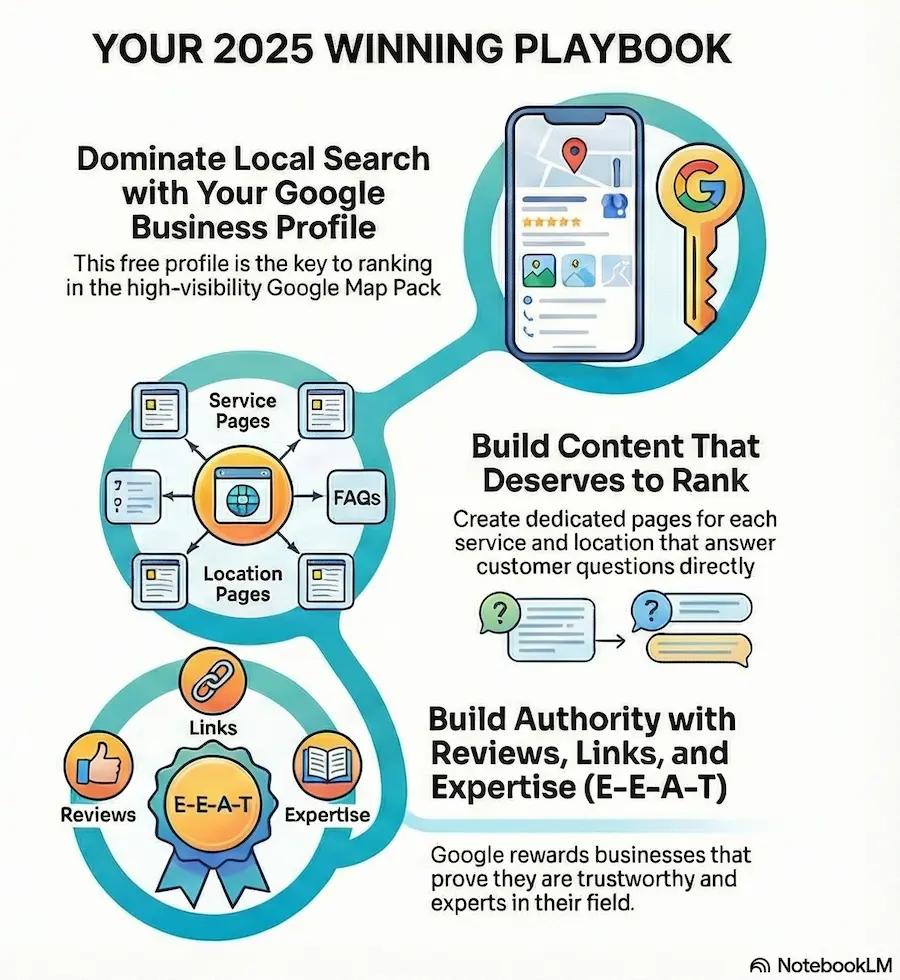
These overviews favor authoritative content with strong E-E-A-T signals: Experience, Expertise, Authoritativeness, and Trustworthiness. The selection algorithm looks for content that is comprehensive, well-structured, and consistent with what authoritative sources say about the topic.
Content signals that earn citations
To become a source Google’s AI trusts, your content needs to demonstrate these qualities:
- Comprehensive coverage — answer the question and the follow-up questions
- Clear heading structure — descriptive H2 and H3 headings that AI can parse
- Cited sources — link to reputable external references when making factual claims
- Established authorship — author bios that prove credentials
- Current information — stale content rarely gets cited
Use content syndication and PR to push your brand out across the web. Google loves nothing better than when someone searches for your business name — that’s one of the primary signals they use to distinguish trustworthy brands from also-rans. Being cited in AI Overviews positions your brand as a trusted authority, even when people don’t immediately click through. That brand familiarity influences the next search, and the one after that.
Step 10: Build Real Authority and Links to Boost Your Ranking
Content quality matters. But Google still relies on external signals to determine which sites deserve to rank. Links from reputable websites remain a core ranking factor. Brand mentions (even without links) and citations contribute to your authority profile.
Local link opportunities
For small and medium businesses, earning these signals doesn’t require a massive PR budget. Start with what’s already in front of you:
- Local sponsorships — community events, youth sports, charitable organizations often link from event websites and local news coverage
- Industry associations — memberships typically include directory listings with links
- Complementary business partnerships — mutual referrals and real links from businesses that serve your same customer
“As backlinks go, your local Chamber of Commerce membership backlink is geographically relevant and certainly worth three or four hundred bucks a year.”
David Victor, Boomcycle Digital Marketing
Join your local Chamber of Commerce. In fact, join the Chamber in every city that matters to you. The membership fee is usually a few hundred dollars; the geographically relevant backlink is worth every penny.
Creating linkable assets
Creating genuinely useful resources gives other sites a reason to reference you. A contractor might publish a comprehensive seasonal home maintenance checklist that local real estate agents want to share with clients. A financial advisor could create a retirement planning calculator that industry blogs find worth linking to. These things compound — each quality link makes the next one easier to earn.
Brand mentions and social signals
Links are the loudest external signal, but they’re not the only one. Brand mentions across the web — your business name cited in articles, directories, and social media — contribute to Google’s understanding of your authority and relevance. When your brand name consistently appears alongside specific keywords in your niche, that pattern reinforces topical authority.
Social media activity won’t directly boost your search rankings, but active profiles serve two purposes that do. First, social profiles often rank on page one for branded searches, giving you more real estate when someone looks you up. Second, content shared on social channels earns more backlinks over time because more people encounter it. A LinkedIn post about a project you completed gets seen by local professionals who might link to your services page down the road.
Step 11: Strengthen Your E-E-A-T Signals
Beyond external links, your site itself must demonstrate trustworthiness. Google’s Quality Rater Guidelines treat E-E-A-T as central to ranking decisions, especially for topics where bad information could cause harm.
Your About page and author bios
Your About page should not be an afterthought. It should tell your origin story, showcase your credentials, explain what makes your approach different, and build genuine connection with potential customers. Specific details earn trust where generalities don’t:
- The year you were founded and how the business started
- Certifications, licenses, and professional memberships — with what they mean to the customer, not just the acronym
- Number of clients served or projects completed
- Named staff with real credentials, not “our team of experts”
Author bios on blog posts should establish why that specific person is qualified to write about that specific topic. “David Victor has been doing SEO since 2003” tells Google a different story than “the Boomcycle team.”
On-site trust indicators
Every one of these signals contributes to Google’s assessment of whether your site deserves to rank for competitive queries:
- Contact information that’s easy to find — phone, address, email
- Clear privacy policy and terms of service
- Real customer reviews and testimonials with photos and full names
- HTTPS across the entire site
- Industry certifications and BBB accreditation displayed where visitors can actually see them — not buried in the footer
Step 12: Fix Your Technical Foundations
Site speed is not a soft ranking signal. Google’s own research found that 53% of mobile users abandon a page that takes more than three seconds to load. Every additional second of load time costs you conversions before anyone has read a single word.
Core Web Vitals and page speed
Core Web Vitals measure the actual user experience: how quickly content loads, how stable the page is as elements render, and how responsive it is to interactions. These metrics directly impact rankings. Pages ranking at position one are 10% more likely to pass Core Web Vitals thresholds than pages in positions two through ten — the correlation is real, not coincidental.
Use Google’s PageSpeed Insights to identify specific issues. Common culprits:
- Oversized images that weren’t compressed before upload
- Render-blocking JavaScript that delays page display
- Missing browser caching on static assets
- Slow server response times (especially on cheap shared hosting)
Most of these have straightforward fixes. None of them require a full site rebuild.
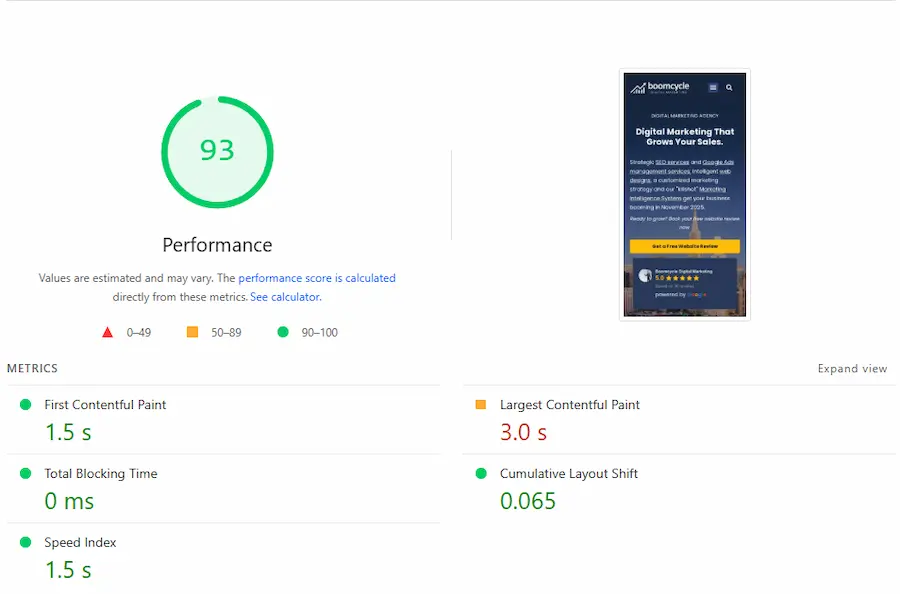
This is about as good as I’ve ever seen an Elementor-based WordPress website do on Google PageSpeed Insights!
Mobile-first indexing
Make sure your site works flawlessly on mobile devices. More searches happen on phones than desktops, and Google primarily uses the mobile version of your site for indexing and ranking decisions. A site that looks great on desktop but breaks on a phone is invisible to most of your potential customers.
Crawlability and indexing
Check Google Search Console regularly for indexing errors, duplicate content issues, and mobile usability problems. Set up an XML sitemap to help Google discover all your important pages. Use robots.txt appropriately to block admin pages while keeping content pages accessible. A slow, broken site can’t rank no matter how good the content is.
Step 13: Turn Visibility Into Leads and Revenue Using Data
Ranking at the top of Google only matters if it drives business results. Traffic is a vanity metric; customers are the goal.
Calls-to-action that convert
Make calls-to-action obvious and unavoidable. Every page should answer three questions within seconds:
- What do you do?
- Why should I trust you?
- What should I do next?
If you want people to call, put your phone number in the header of every page with click-to-call functionality on mobile — 70% of people searching on a phone will call directly from the results page if you make it easy. If you want form submissions, keep forms to the essential fields. Studies consistently show that adding even one extra field reduces conversions by 10-15%.
Trust signals matter enormously at the conversion stage. Prominent reviews, testimonials with photos, industry certifications, guarantees, and professional imagery all contribute to the credibility that turns a visitor from “maybe” to “call now.”
Mobile conversion optimization
Test your mobile experience relentlessly. Can someone call you with one tap? Are forms simple to complete on a small screen? Do images load quickly? Is the purchase process frictionless? Most business owners test their sites on a desktop once, then forget that the majority of their customers are on a phone.
Step 14: Track What Actually Matters
Vanity metrics like total keyword rankings or domain authority scores feel good but don’t pay the bills. Focus on metrics that connect to actual business outcomes.
Metrics that connect to business outcomes
On the visibility side, monitor:
- Organic traffic trends — overall, and branded vs. non-branded separately
- Rankings for your most important commercial and local searches
- Presence in SERP features: snippets, People Also Ask, Map Pack positions, and AI Overview citations
On the revenue side, track what actually matters:
- Phone calls from organic traffic
- Form submissions and quote requests
- Direction requests to your location
- Online purchases attributable to organic search
Set up goal tracking in Google Analytics 4. Use call tracking numbers if phone leads matter to your business. Connect your CRM to understand which organic traffic sources produce customers with the highest lifetime value.
Step 15: Set Realistic Expectations
SEO is not a quick fix.
Meaningful results typically take months, not weeks. How long depends on your starting point, your competition, your domain’s age, the resources you invest, and — frankly — how often Google updates its ranking algorithm. A brand-new site targeting competitive keywords in a major market might need six to twelve months before seeing significant traction. An established local business optimizing an existing site might see Map Pack improvements within weeks.
Here’s why the timeline is worth it: organic search costs 61% less per lead than paid advertising, and the median SEO ROI is 748%. Unlike ads that stop working the moment you stop paying, organic rankings compound. Each improvement builds on previous work. Authority accumulates rather than resets.
Ranking for “personal injury lawyer in New York City” faces exponentially more competition than “family dentist in small-town Iowa.” Know your market. Patience paired with consistent execution wins.
Step 16: Know When to Get Help
Some SEO work is DIY-friendly for business owners with time and willingness to learn. Other elements require specialized expertise, enterprise tools, or simply more hours than a business owner has to spare. Here’s an honest breakdown:
| DIY-Friendly | Worth Hiring a Professional |
|---|---|
| Claiming and optimizing your Google Business Profile | Technical SEO audits and fixes |
| Requesting customer reviews | Large-scale content production |
| Writing service and location page copy | Competitive link building campaigns |
| Publishing helpful blog content | Advanced Google Analytics 4 setup |
| Updating business info in directories | Systematic conversion rate optimization |
The real question isn’t whether you could learn to do it yourself. It’s whether your time is better spent on this versus running your actual business.
A skilled SEO professional or agency brings experience across dozens of clients, access to enterprise-level tools, and the ability to avoid costly mistakes that waste months of effort. The businesses that reach the top of Google consistently share one trait: they treat search visibility as a long-term strategic investment, not a one-time project.
Getting to the top of Google in 2026 is more complex than it used to be. It’s also more achievable for businesses willing to commit to a clear strategy, measure what matters, and build systematically over time. Start with the steps that matter most for your business type. Each one you complete makes the next one easier. If you would rather not run it yourself, here are our SEO services.